


Facial Reanimation Using Gracilis Free Flap Surgery
Facial expressions are one of the most powerful tools of communication in our social life. Especially expressing emotions such as smiling, sadness or happiness allows us to connect with people. However, conditions such as facial paralysis can lead to the loss of these expressions and this can create serious difficulties both aesthetically and psychologically. At this point, Gracilis Free Flap Surgery stands out as one of the most effective solutions offered by modern medicine. You can take a look at our content to get detailed information about this procedure and to eliminate the question marks in your mind. In this way, you can have information about what Gracilis flap surgery is and how it is performed. We wish you all healthy days and good reading.
What is Facial Reanimation Using Gracilis Free Flap Surgery?
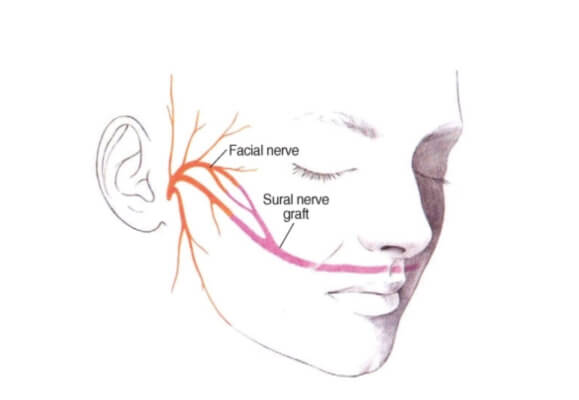
A procedure used in facial paralysis, Gracilis flap surgery is an advanced microsurgical method used for facial reanimation, especially in patients who have lost facial movements due to facial paralysis (facial paralysis). This method is realized by moving the gracilis muscle located in the inner thigh to the facial area. This muscle is a suitable option for restoring facial movements with its thin and long structure, and at the same time, it allows the application of microsurgical techniques with its strong vascular and nerve connections. In this context, dynamic facial movements such as facial symmetry and smiling can be performed comfortably. For this reason, it is also a frequently applied procedure in patients with facial paralysis.
In Which Situations Is Gracilis Flap Surgery Applied?
How is Facial Reanimation Performed Using Gracilis Free Flap Surgery?
Contrary to popular belief, facial reanimation using Gracilis Free Flap Surgery is a very easy and short procedure.However, it is also a procedure that requires a lot of attention and must be carried out meticulously.For this reason, Gracilis flap surgery should be performed by physicians.In this way, you can achieve perfect and good results.
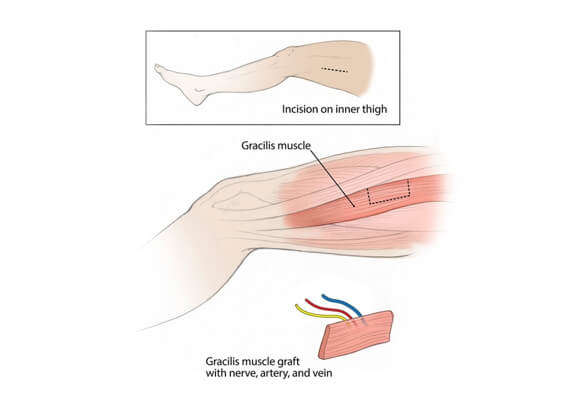
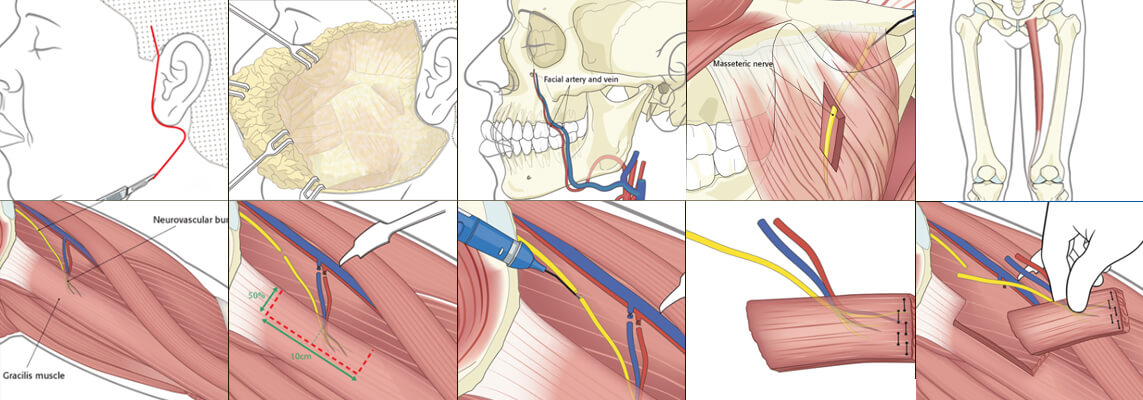
At this point, first of all, the patient who will undergo Gracilis flap surgery should be under general anesthesia.Thus, the patient does not feel any pain or ache during the procedure.Afterwards, the doctor evaluates the patient's facial anatomy, duration of paralysis and nerve sources and carefully removes the gracilis muscle located on the inner thigh, preserving the artery, vein and nerve connections of the muscle.This removed muscle is shaped to provide mimic movements and transferred to the affected area of the face. Then, in the microsurgery stage, the arteries and veins of the gracilis muscle are connected to the appropriate vessels in the facial area (for example, facial artery and vein), providing the blood circulation necessary for the muscle to survive. Afterwards, the tension is adjusted to achieve an aesthetically and functionally correct position in the area where the muscle is placed. After the adjustment, the patient gradually regains consciousness and a long recovery period awaits the patient. This procedure is an effective method to restore facial movements and offers both aesthetic and functional results with correct surgical planning and application.
Advantages of Facial Reanimation Using Gracilis Free Flap Surgery
Gracilis flap surgery applied to the face has certain advantages for the patient. These advantages provide the patient with many physical and psychological benefits.These advantages are as follows;
- Restores Dynamic Facial Movements: Since the Gracilis muscle is an active muscle, it can recreate dynamic facial movements such as smiling, unlike static methods.Therefore, the procedure offers the patient natural and flawless results.
- Provides Natural and Aesthetic Appearance: Since the muscle structure is long and thin, it can be shaped in accordance with the facial anatomy.Thus, the face area is given a natural and aesthetic appearance.
- High Success and Survival Rate: Since the Gracilis muscle is a well vascularized structure, it can easily sustain blood circulation in the area where it is transferred and reduces the risk of infection.
- Long Term Permanent Results: Provides permanent restoration of movement and elimination of asymmetry caused by facial paralysis.
- Lower Risk of Complications: Complications such as infection, bleeding or flap loss are rare when performed by a team with microsurgical experience.
- Improves Patient Self-Confidence and Social Life: Restoring dynamic facial movements improves the patient's facial aesthetics and expressions, creating positive psychological and social effects.
- Suitability for Different Reconstruction Needs: In addition to facial reanimation, it can also be used for other complex repairs when necessary (e.g. perineal or extremity reconstructions).
- Rehabilitation and Compliance: With physiotherapy after surgery, the function of the muscle can be further optimized and the patient can learn new movements.
Before Facial Animation Using Gracilis Free Flap Surgery What to Pay Attention to?
There are some minor points to be considered before the gracilis flap surgery operation. These points to be considered are very important for the success of the surgery. These points are as follows;
- A detailed health screening should be performed to assess the patient's suitability for surgery. Any systemic diseases such as diabetes, hypertension or clotting disorders should be controlled.
- Patients who smoke are advised to quit smoking before surgery as it may adversely affect the healing process.
- The duration and severity of facial paralysis and the current condition of the nerves should be examined. In persistent facial paralysis, the nerve source that will provide movement (such as the masseter nerve or the facial nerve of the opposite face) should be evaluated.
- Alternative methods should be considered if an intact nerve supply is not available.
- The thigh area where the Gracilis muscle will be removed should be carefully examined. The muscle's blood supply, nerve connections and overall textural compatibility should be checked.
- If there is any condition that may adversely affect wound healing in the donor area, precautions should be taken.
- The direction, position and tension of the muscle should be planned in advance in accordance with the anatomical and aesthetic goals of the surgery.
- It should be explained that it may take time to regain full postoperative movement and that significant results may take several months.
- A team with microsurgical experience must be organized to perform the surgery. High precision is required to correctly integrate the vascular and nerve connections of the Gracilis flap into the facial area.
- Providing information about the results of the surgery and the healing process ensures that the patient is psychologically prepared for the postoperative period. Psychological support can be offered if necessary.
- If the patient is taking blood thinners, they may need to be stopped before surgery. The physician's instructions regarding this should be followed.
- The patient should be prepared for postoperative care and physiotherapy. Necessary equipment for home care or support from relatives should be planned.
After Facial Animation Using Gracilis Free Flap Surgery What to Pay Attention to?
As with every operation, there are points to be considered after Gracilis flap surgery. While these points accelerate your healing process, they also help you get positive results after the operation. For this reason, here are the things you should pay attention to during the procedure;
- In the first few days after surgery, the blood supply to the flap and the functionality of the nerve connections should be carefully monitored. The patient should also be checked regularly for the risk of impaired blood circulation or flap loss.
- The risk of postoperative infection should be reduced. For this purpose, appropriate antibiotic treatment can be started and wound care should be paid attention.
- It may take several months for the nerve connections to become effective. During this time, regular assessments should be made to ensure that the muscle starts to move.
- Facial exercises should be performed with a physiotherapist to develop dynamic facial movements. These exercises train the muscle for expressions such as smiling.
- In the post-surgical period, the patient should be followed up regularly to improve facial symmetry. Mild asymmetries may improve over time. However, additional corrective procedures may be required for significant problems.
- Wound healing should be checked in the thigh area where the Gracilis muscle was removed. Any complications such as infection, hematoma or pain should be treated quickly.
- A healthy and balanced nutrition program should be recommended to speed up the recovery process after surgery.
- Habits such as smoking and alcohol should be avoided, which can negatively affect recovery.
- Psychological support can be provided during this process when the patient regains facial movements. Being able to control facial expressions increases the patient's self-confidence and improves their social life.
- In order to detect complications such as flap loss, wound dehiscence, hematoma or problems with nerve connections early, it is important that the patient closely monitors himself/herself and seeks medical attention immediately in case of symptoms.


